
Everyone’s talking about AI, but where’s the real business value? Strip away the buzzwords, and you’ll find AI automation delivering tangible results right now. The automation revolution isn’t coming – it’s already here, transforming operations across industries and creating competitive advantages for early adopters.
In 2026, we’ll see these benefits compound as technologies mature and implementation barriers fall. Let’s explore how AI automation is creating measurable business impact and why 2026 might be your most transformative year yet.
Top AI Automation Benefits Transforming Businesses
The business world has reached an inflexion point with AI automation. We’re moving beyond the experimental phase into an era where automation delivers concrete, measurable advantages. What started as simple task automation has evolved into sophisticated systems that can handle complex workflows, analyse massive datasets, and even make nuanced decisions.
Companies implementing AI automation today aren’t just preparing for the future – they’re gaining immediate advantages over competitors stuck in manual processes and legacy systems. In fact, businesses using AI automation report an average 30% higher productivity compared to those relying on traditional methods, according to McKinsey.
Many companies adopt an AI solution for business to automate workflows and reduce manual effort across operations.
Time Savings and Task Automation
The most immediate benefit of AI automation is reclaiming time previously lost to repetitive tasks. Modern AI systems excel at handling predictable, rule-based processes that once consumed valuable human attention. Think about what your team could accomplish if they weren’t bogged down with:
Data entry and validation
Report generation and distribution
Calendar scheduling and meeting coordination
Email filtering and response drafting
Document processing and information extraction
Companies implementing AI workflow automation typically see a 40-70% reduction in time spent on routine tasks. This isn’t just about efficiency – it’s about unlocking human potential. When teams are freed from mundane work, they can focus on strategic thinking, creative problem-solving, and high-value customer interactions.
Take customer support, for example. AI chatbots now handle 68% of routine inquiries without human intervention, allowing support staff to focus on complex issues that truly require human empathy and problem-solving skills, according to Gartner.
Cost Reduction and Operational Efficiency
AI automation delivers substantial cost savings through multiple channels. The most obvious is labour cost reduction – not necessarily through staff cuts, but by increasing productivity and enabling growth without proportional increases in headcount.
Beyond labour savings, AI automation reduces costs by:
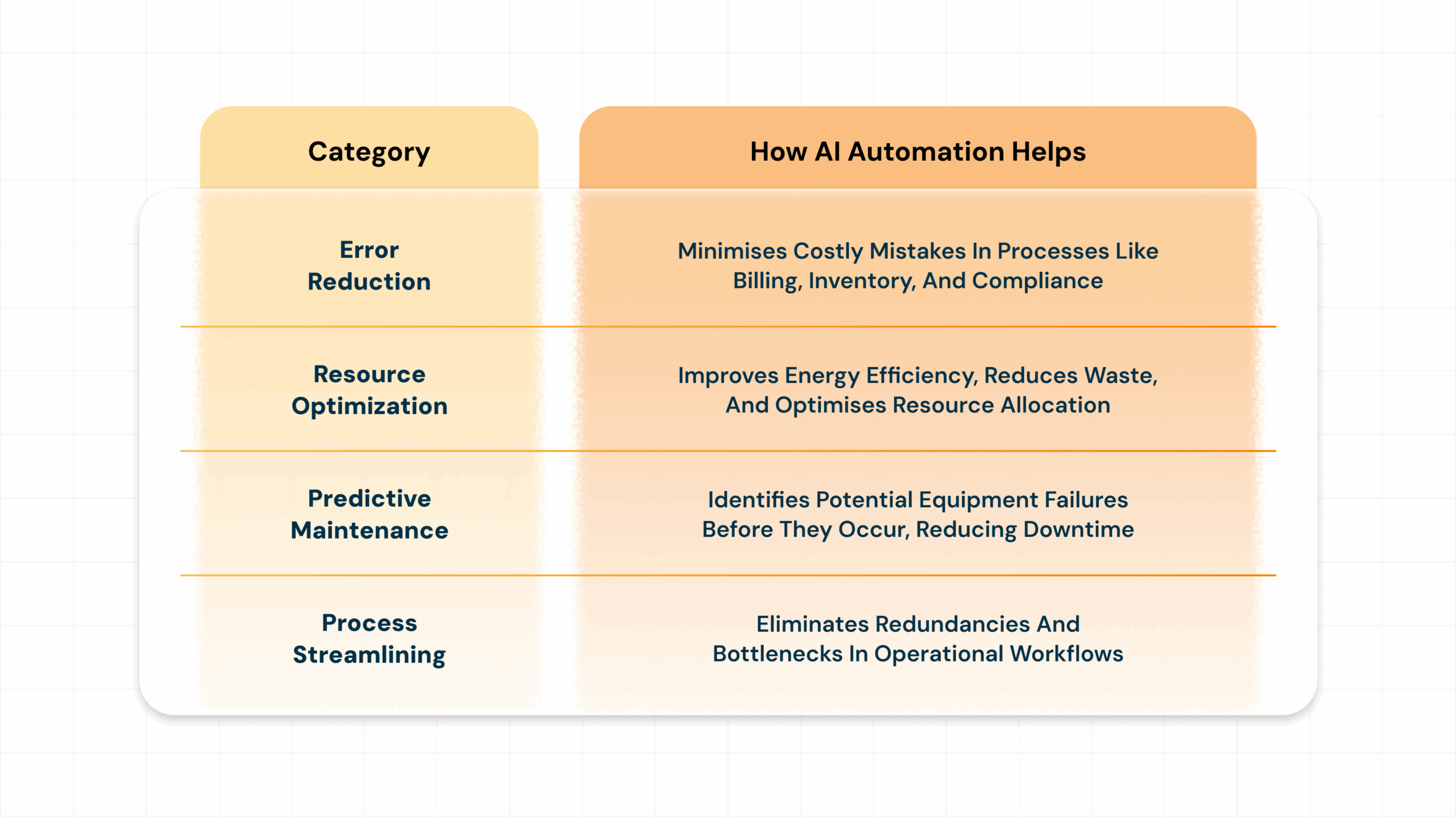
Manufacturing operations implementing AI-powered predictive maintenance have reported maintenance cost reductions of up to 25% and unplanned downtime reductions of up to 50%.
Revenue Growth and New Opportunities
AI automation isn’t just about cutting costs – it’s increasingly driving revenue growth through enhanced customer experiences and new business models. Smart companies are using AI to:
Personalise at scale – Delivering customised experiences without proportional staff increases
Identify upsell opportunities – Recognising patterns in purchase behaviour that humans might miss
Optimise pricing – Adjusting prices dynamically based on demand, competition, and customer value
Create new products – Using AI to develop entirely new offerings or enhance existing ones
E-commerce businesses implementing AI-powered recommendation engines have seen revenue increases of 10-30%, while those using dynamic pricing algorithms report margin improvements of 5-15%.
Decision-Making and Data Accuracy
Perhaps the most transformative benefit of AI automation is its impact on decision quality. AI systems can analyse vast datasets, identify subtle patterns, and generate insights far beyond human capabilities.
This translates to better business decisions through:
More comprehensive data analysis (no more sampling or gut feelings)
Reduced cognitive bias in interpretation
Consistent application of decision criteria
Continuous learning and improvement of decision models
Financial institutions using AI for loan approval decisions have reduced default rates by up to 25% while simultaneously increasing approval rates for qualified applicants by 15%..
24/7 Operations and Scalability
AI automation systems don’t sleep, take vacations, or call in sick. They operate continuously, maintaining consistent performance levels regardless of time or workload. This unlocks several key advantages:
Global operations without shift-based staffing challenges
Ability to handle sudden demand spikes without service degradation
Consistent customer experience across all touchpoints and time zones
Rapid scaling without proportional cost increases
E-commerce companies leveraging AI automation for customer service report 67% improvement in first-response time and 35% higher customer satisfaction scores, largely due to 24/7 availability.
AI Workflow Automation Software and Tools
List of Leading AI Automation Platforms
The AI automation landscape offers solutions for various business needs and technical capabilities. Here’s a rundown of standout platforms across different categories:
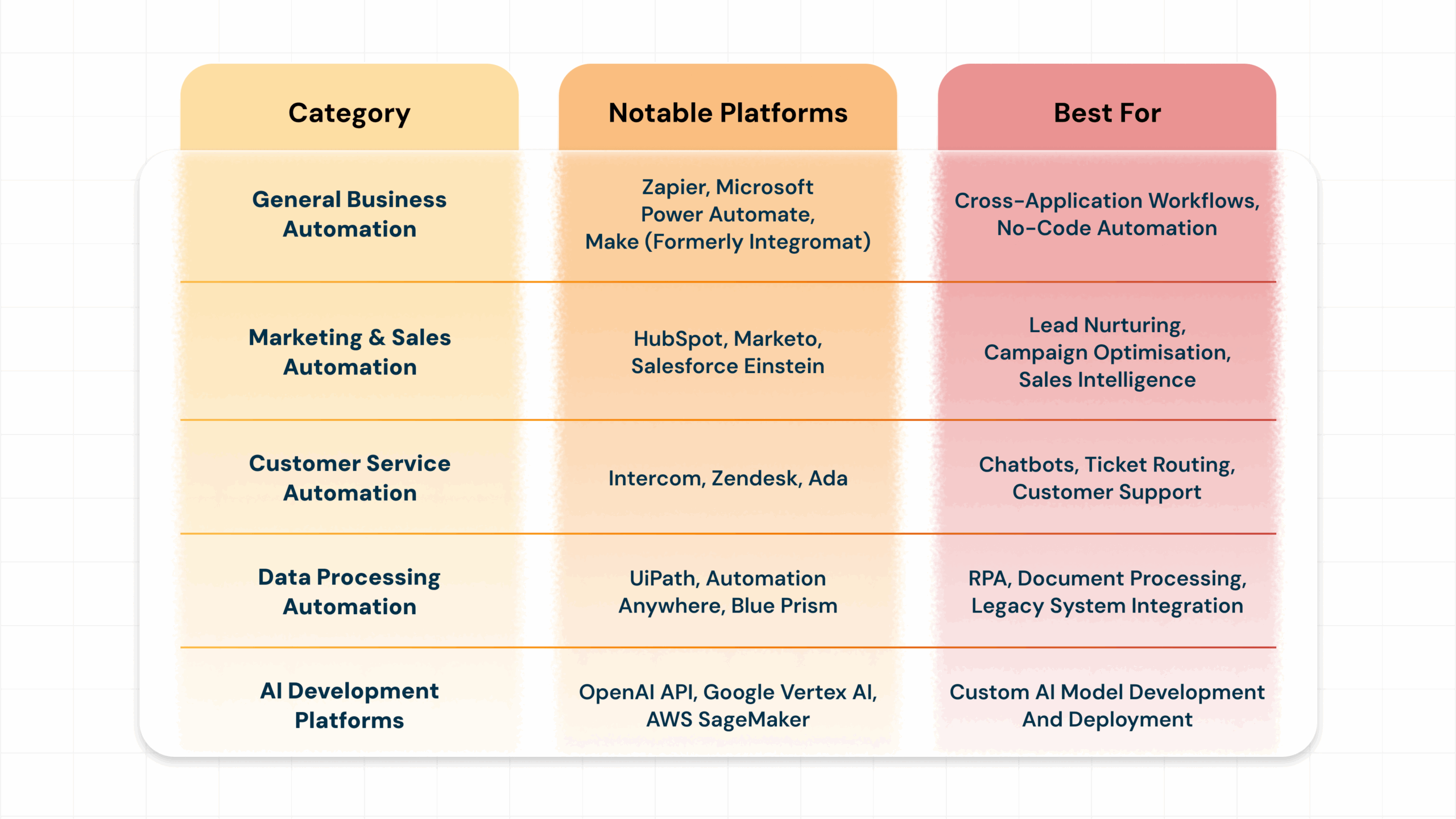
The most effective implementations often combine multiple tools – for example, using RPA for structured data tasks while deploying conversational AI for customer interactions.
Key Features to Look for in AI Tools
With so many options available, evaluating AI automation tools requires focusing on the features that deliver real business value. Prioritise these capabilities when selecting your automation stack:
No-code/low-code interfaces – Enable business users to create automations without deep technical knowledge
Pre-built templates and connectors – Accelerate implementation with ready-made solutions for common use cases
Robust API ecosystem – Ensures seamless integration with existing systems and data sources
Scalability – Handles increasing workloads without performance degradation
Explainability – Provides transparency into how decisions are made (critical for regulated industries)
Continuous learning capabilities – Improves performance over time through feedback loops
Advanced analytics and reporting – Demonstrates ROI and identifies optimisation opportunities
Tools offering both specialised excellence and broad applicability typically deliver the greatest long-term value. Look beyond flashy demos to understand how a platform performs with your specific data and use cases.
Implementation Strategies and Best Practices
Successful AI automation implementations follow a strategic approach rather than randomly automating processes. Follow these best practices to maximise your chances of success:
Start with process analysis – Document current workflows and identify high-value automation candidates
Prioritise quick wins – Begin with simple, high-return processes to build momentum and demonstrate value
Create cross-functional teams – Combine business domain experts with technical specialists
Implement robust change management – Prepare employees for new ways of working
Build feedback mechanisms – Continuously gather user input to refine automations
Plan for exceptions – Design human-in-the-loop processes for cases the AI can’t handle
Measure and communicate results – Track KPIs before and after implementation
Remember that AI automation is a journey, not a one-time project. The most successful organisations cultivate an automation mindset across the organisation, continuously identifying new opportunities to apply AI for business advantage.
How Codesis Technologies Makes AI Automation Real
At Codesis Technologies, we take a hands-on approach to automation. This isn’t about trendy tools; it’s about embedding automation into your operations so it actually delivers. We work with you to automate key workflows, link your systems, reduce manual effort, and create data-driven decision loops across your business.
Whether it’s automating customer-support journeys, processing unstructured data such as documents and forms, enabling finance teams with faster reconciliations and validations, or building industry-specific agents for sectors like Fintech, Proptech, and Healthtech, we aim to shift your business from reacting to forecasting and acting with confidence.
By turning routine tasks into automated flows and freeing your team to focus on value-added work, we help you move from efficiency gains to strategic advantage.
Measuring AI Automation ROI and Business Impact
Key Performance Metrics and KPIs
Measuring AI automation success requires both quantitative metrics and qualitative assessments. Track these key indicators to demonstrate business impact:
Time metrics
Process completion time (before vs. after)
Employee hours saved
Time to market for new products/services
Financial metrics
Direct cost savings
Revenue increases attributable to automation
Customer lifetime value changes
Implementation and maintenance costs
Quality metrics
Error rates
Accuracy percentages
Compliance violations
Customer metrics
Customer satisfaction scores
Net Promoter Score changes
Resolution times
Employee metrics
Job satisfaction
Productivity per employee
Retention rates
The most compelling ROI calculations combine multiple metrics to tell a complete story about automation impact.
Industry Benchmarks and Success Rates
AI automation performance varies significantly by industry, but understanding benchmarks can help set realistic expectations and goals:.
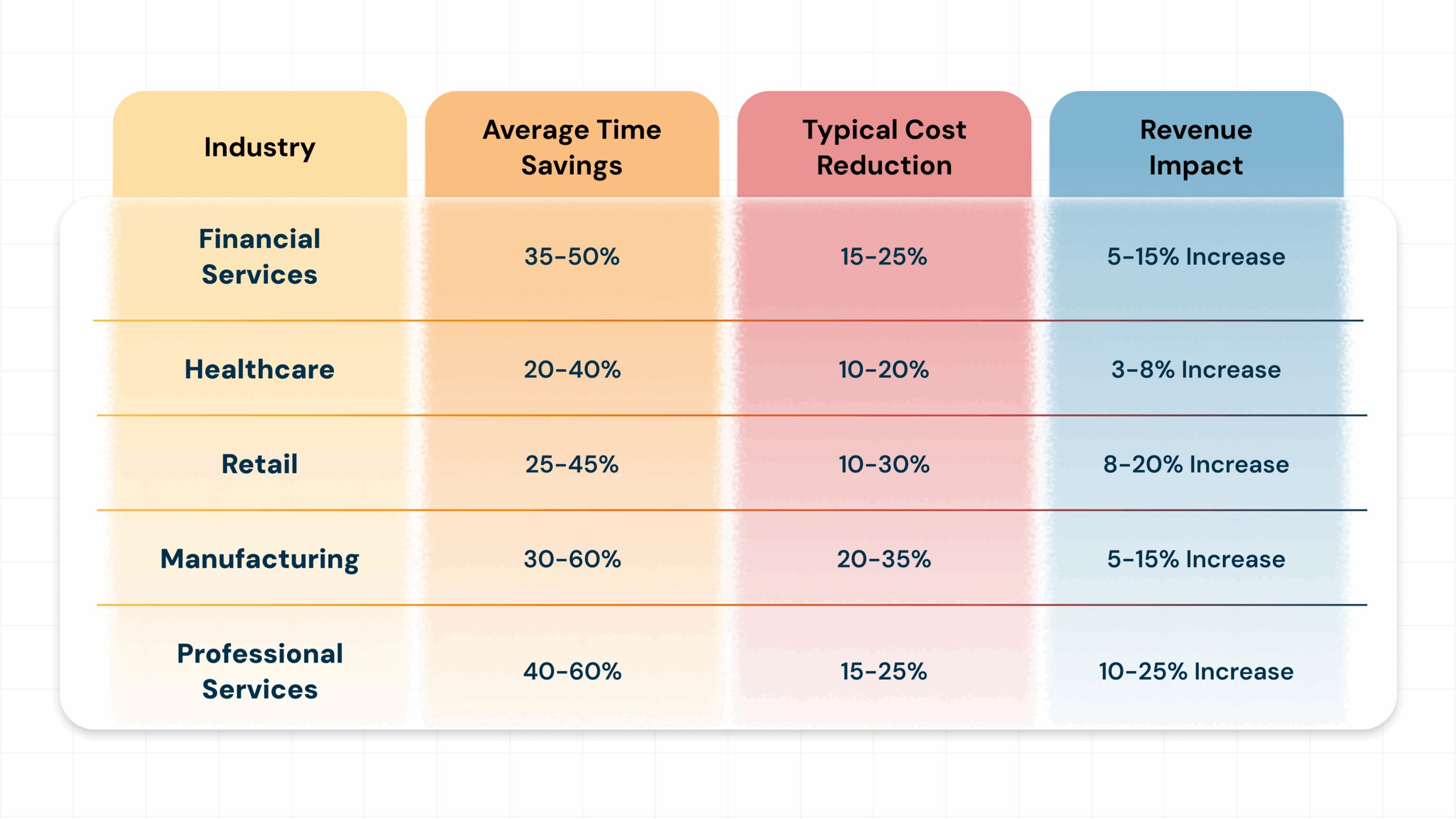
Remember that these are industry averages, your results may vary based on your specific processes, implementation quality, and organisational readiness.
Building Your Business Case for AI
A compelling business case for AI automation goes beyond ROI calculations to address all stakeholder concerns. Include these elements in your proposal:
Current state assessment – Document pain points and inefficiencies in existing processes
Opportunity sizing – Quantify the potential value of automation (time, money, quality)
Implementation roadmap – Outline phases, timelines, and resource requirements
Risk assessment – Identify potential challenges and mitigation strategies
Success metrics – Define how you’ll measure and report outcomes
Competitive analysis – Show how peers and competitors are leveraging similar technologies
Frame AI automation as a strategic investment rather than just a cost-cutting measure. The most successful business cases emphasise how automation enables innovation, improves customer experience, and creates competitive advantage.
Partnering with the Right AI Implementation Expert: Codesis Technologies
Codesis Technologies specialises in end-to-end product development that integrates AI automation into your business processes. Their comprehensive approach begins with in-depth research and extends through deployment and ongoing support, ensuring your automation solutions are both scalable and precisely tailored to your specific business requirements.
Their service portfolio includes:
Advanced web and mobile application development with AI integration capabilities
Custom e-commerce solutions that leverage AI for personalisation and optimisation
Intuitive UI/UX design that makes advanced AI functionality accessible to all users
Comprehensive frontend and backend development with seamless AI workflow implementation
CMS integration that incorporates AI content management capabilities
Digital transformation strategies that position AI automation at the core of business operations
Codesis stands out through its digital-first approach, which drives multi-channel user experiences while increasing conversion rates and boosting ROI. Their commitment extends beyond implementation, they provide robust software maintenance that resolves issues and future-proofs your applications as AI technology evolves.
Their development methodology incorporates:
Efficient sprint planning for rapid iteration and feedback
Iterative delivery that adapts to changing requirements
Rigorous testing and quality assurance to ensure reliability
Modern code architecture is designed for scalability and performance
Strategic DevOps practices that streamline deployment and updates
This systematic approach ensures consistent, high-quality results across diverse industries. Codesis has successfully built digital solutions incorporating AI automation for clients in Fintech, Proptech, Healthtech, Edtech, and Ecommerce, demonstrating their versatility in aligning automation technology with specific business requirements across sectors.
To explore how AI automation can fit into your business workflow, connect with the Codesis team today.